

Uzbekistan’s Havas Brand Valued at $112 Million
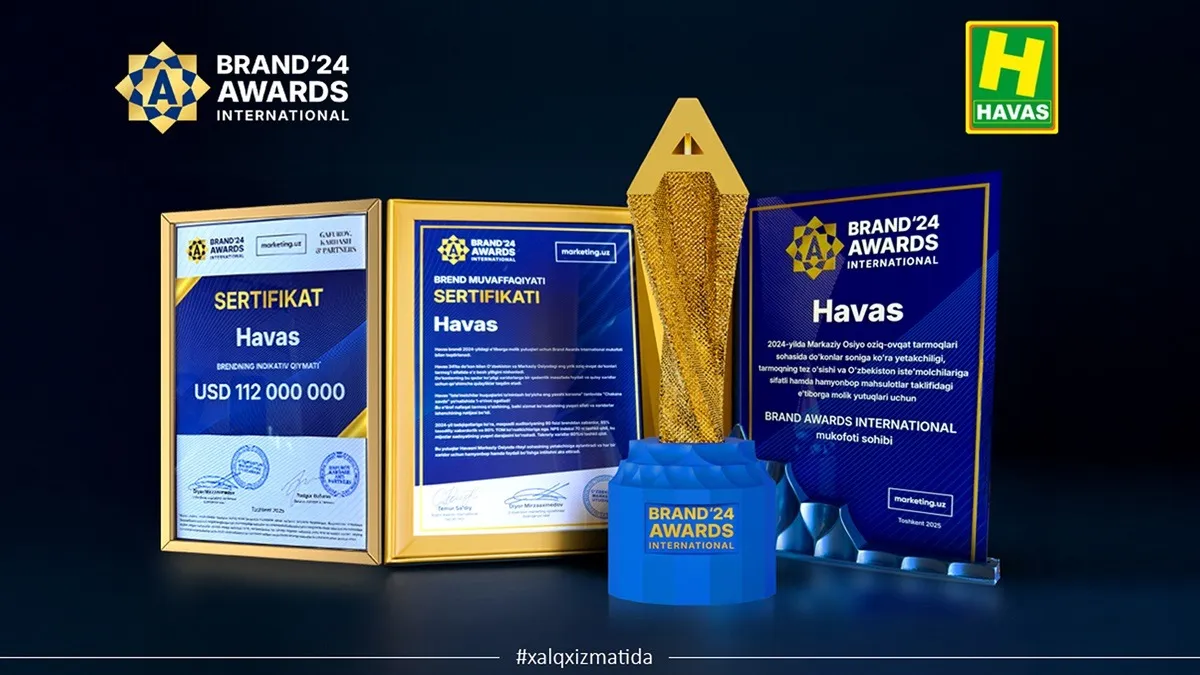
On May 3–4, the Brand'24 Awards International ceremony took place in Tashkent, organized by the Marketing Association of Uzbekistan. Based on a series of comprehensive marketing studies, the Havas discount chain received several awards. The Association highlighted Havas’ significant contribution to the development of the country’s retail sector and officially recognized it as the largest retail network in Uzbekistan, currently comprising 341 stores.
As part of the event, the Marketing Association also presented the results of an independent brand valuation for Havas — the country’s largest discount retailer. According to the findings, the brand’s estimated value, excluding any operational assets or financial metrics, stands at $112 million.
The valuation was based on a methodology that considered projected revenues, royalty rates, discount factors, and a set of intangible indicators including brand awareness, customer trust, and brand strength in a competitive environment. The financial analysis was conducted by Gafurov, Kardash & Partners — a consulting firm with international expertise in corporate finance and audit.
Importantly, the valuation does not reflect the company’s tangible assets, operational income, or market share. Rather, it represents an indicative market value of the brand as an independent intangible asset with economic potential and investment significance.

Havas: Structure and Business Model
Founded in 2018 by entrepreneur Fathullo Sadikov, Havas has grown into the largest discount retail chain in Uzbekistan and one of the fastest-growing players in Central Asia. As of March 2025, the company operates 341 stores, primarily in Tashkent and the surrounding region, with an active strategy for regional expansion.
Havas follows the “convenience store” model, offering a wide range of daily essentials — from groceries to household goods — at affordable prices. A substantial portion of the assortment is comprised of private label products, allowing the company to maintain both quality control and pricing competitiveness. The operating model is built around standardized processes, centralized procurement, and integrated logistics management.
According to data presented at the Brand’24 Awards International, brand recognition among Havas’ target audience reached 90% in 2024. The company reported a Net Promoter Score (NPS) of 70% and a 60% repeat purchase rate, indicating strong customer engagement and loyalty.

Brand Valuation: A New Milestone for Uzbekistan’s Private Sector
Formal brand valuation remains a rare practice in Uzbekistan’s private sector. In this context, the Havas case is a landmark: one of the first instances where a domestic mass-market brand has received a substantiated market valuation confirmed by independent experts.
From an economic standpoint, such valuations pave the way for more structured management of intangible assets. In many jurisdictions, brand value is already recognized in financial reporting, influences access to capital, and plays a critical role in mergers and acquisitions. For Uzbekistan’s business environment, developing this practice signals a move toward international standards of valuation and transparency.
For the company itself, an independent brand valuation creates opportunities to integrate intangible value into investment planning, engagement with financial institutions, and long-term corporate initiatives.

What Havas’ Valuation Means for Uzbekistan’s Retail Market
In an increasingly competitive food retail landscape, brand valuation becomes a practical tool — a verified indicator of market capitalization and intangible strength. The Havas case demonstrates that even in the budget retail segment, a brand can function as a standalone economic asset.
The established brand value is not merely declarative — it serves as a benchmark that can be factored into negotiations, transactions, and strategic partnerships. For the market, it’s a signal that intangible assets are gaining institutional recognition and can be treated as a tangible component of business valuation.